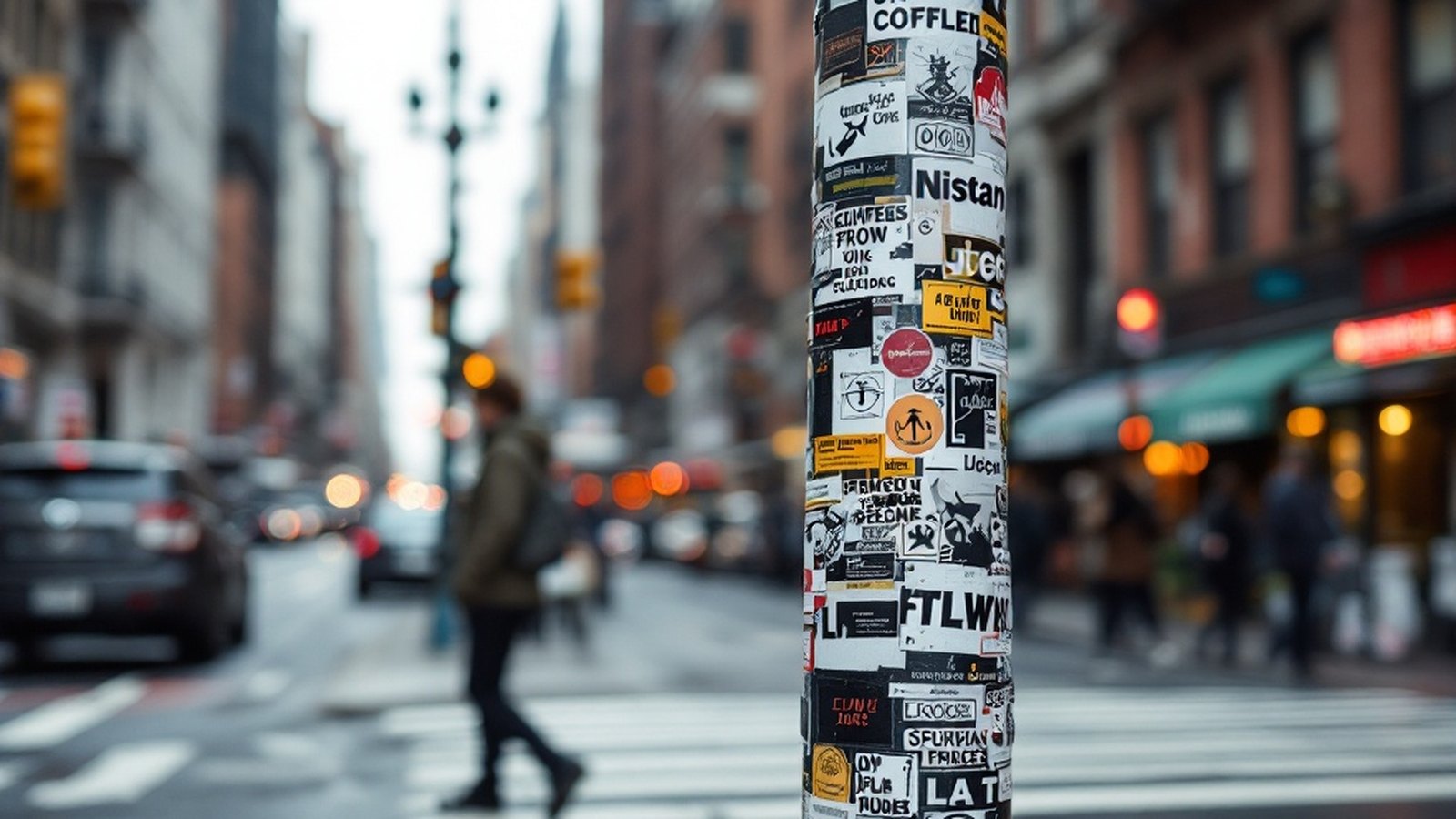
A sticker costs cents. A well-placed one gets seen by ten thousand people before the city scrapes it off. That's the math that's driven writers and artists to slap since at least the early 1990s, when custom-printed labels and modified USPS "Hello My Name Is" tags gave anyone with a design and a flat surface an instant distribution network. No wall permission required. No ladder. No lookout.
01Reading the Lamppost
Learn to read a lamppost and you're reading the neighbourhood. The clusters tell you who's been through — bombers, illustrators, political agitators, punks — and the layers tell you how long ago. A sticker at knee height was slapped by someone crouching fast, nervous. Eye level is confident. Above eye level means they stood on a bike peg or a friend's shoulders and really wanted the burn.
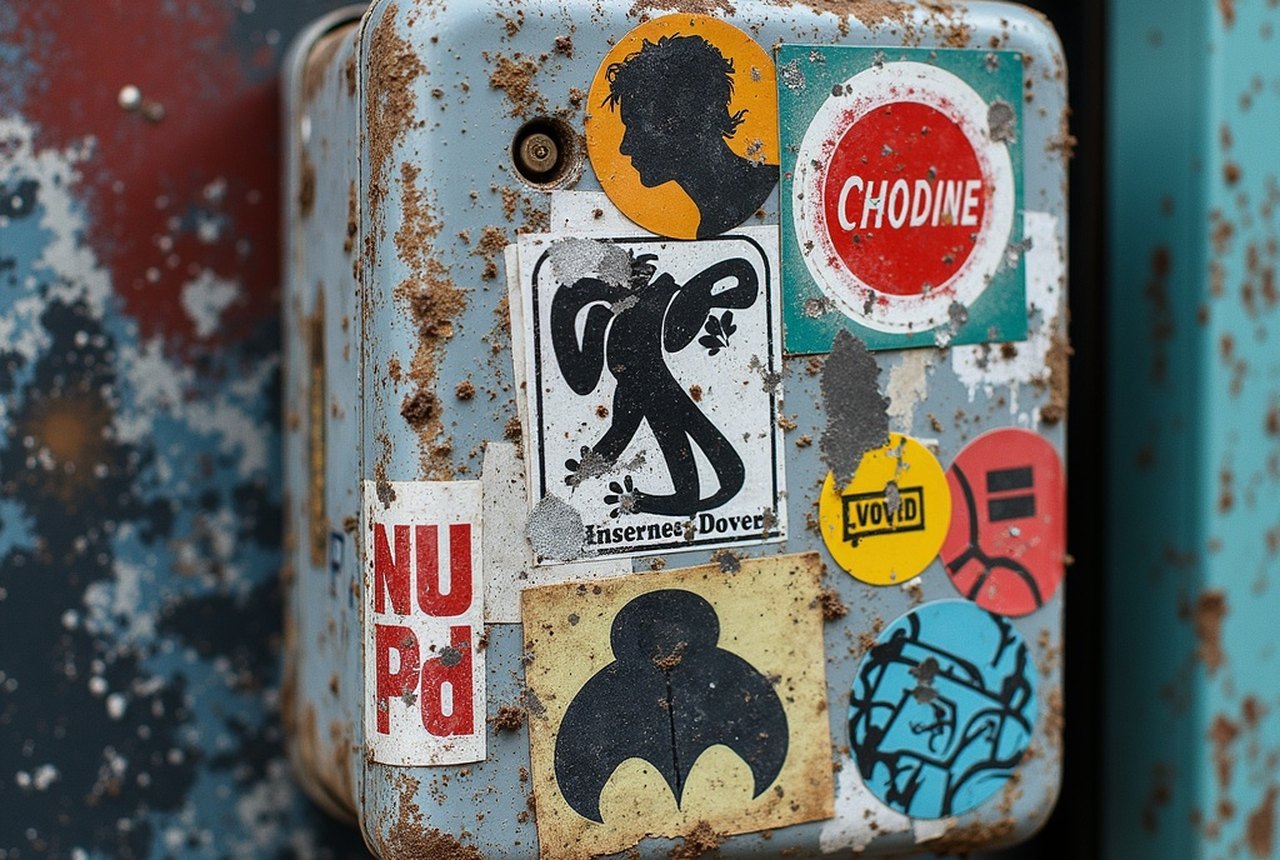
The hot spots are predictable: sign poles at busy pedestrian crossings, newspaper boxes (while they last), utility junction boxes, the backs of stop signs, fire hydrants, scaffolding pipes, and the metal doors of closed corner stores. Surfaces that won't take wheat-paste absorb stickers beautifully, which is why a city full of cold, painted steel is basically a sticker paradise.
Subway cars are largely gone as the wild canvas they were, but station infrastructure — the gap between a poster frame's edge and the wall, the flat back of a MetroCard machine — still gets worked. The culture didn't leave the trains; it displaced.
02Etiquette and Churn
There is an unwritten code, loose but real. You don't slap over someone else's face, especially a portrait. You read the existing strata before you add to it — if a pole is already a dense archive, you're contributing to something. Throwing up a sloppy commercial sticker in the middle of a tight little community of hand-drawn slaps is considered bad form, same as bombing over a finished piece.
Churn is fast. The Department of Sanitation's anti-graffiti unit hits poles regularly in busier BIDs — Midtown, Downtown Brooklyn, the more sanitized strips of Williamsburg. The outer boroughs breathe longer. A good slap in Ridgewood or Sunset Park might survive a year; the same slap outside a Soho boutique is gone in a week.
The medium self-curates. What survives long enough to be photographed, layered over, referenced — that's the canon.
Either way, nothing on a pole is permanent, so slap knowing it may be gone by next month.
Field kit: eyes at knee height and above; check sign-pole backs, hydrants, scaffolding pipes and the flat back of the MetroCard machine.